Thursday, 17 December 2020

Omnivors

As stated by Wiki, an animal that has the ability to survive on plant and animal matter. And there are of course many sub-categories such as Frugivores - maned wolf and orangutans to name two; Frugivores favour fruit but can eat meat. Being omnivorous (from Latin - all, and vorare - to eat or devour) gives the omnivore more food security in stressful times and or makes living possible in less consistant environments. The page was massively longer and in depth than these couple of sentences but in the light of a Guardian article yesterday on the growth of lab-produced meat I just wanted to re-check the definition of what us humans are categorised as.

Lab-grown meat. Hmm. Somehow, I find this idea and practice deeply worrying and repulsive. In one way it could be a way of ceasing to breed and kill animals to slake our meat-hunger, but the fact that the process requires the use of 'bovine serum' - blood taken from calf foetuses - doesn't really remove the finished products from the usual meat-producing system. Also, according to the article's writer the 'meat' she was served up tasted like bland chicken nugget flesh, so that cuts out all restaurant dishes other than KFC etc. It's all getting a little to close to Soylent Green for my liking. What about just eating lentils, rice and heaps of vegetables? or, if in our case, mostly that with an occasional roast chicken or mackerel dish for a bit of extra protein.

Certainly where we live in France people would be pushing the vegetables around their plate hunting for the meat, and I have a friend who's husband insists on meat at EVERY meal, even breakfast. At Ezra's old school I picked up a pamphlet that stated being a vegetarian was dangerous for children. Vegetarianism is regarded as a sort of affliction here, the couple of specialist restaurants I've been in serving up dull, tepid, flavourless concoctions as if it serves you right for being a weedy vegetable-eater.

Something has to change, that's for sure, in regard to our health and the future of this maligned planet but adding more complex, planet-damaging and fuel-costly industrial processes to food production seems a very wrong direction.

                                                                                ***

Following, a possibly appropriate extract from my novel, Londonia, set in 2072, in which our heroine, Hoxton, is being taken to visit the mysterious ex-tube train tunnels beneath The Cincture. 


‘Iona?’

‘Yes?’

‘What is in the tunnels?’
‘Something you won’t want to see. In fact I want to come 
with you, and I think we should attire you in something other than the allinone."

Half a Cincture hour later, I’m dressed in a long peacock- blue dress with matching handbag, other hand clutching a small white parasol.

‘Why do I need this?’ I ask, fiddling with the up-and-down mechanism as we wait for another shaw.

She collapses her own miniature umbrella as our carriage arrives. ‘You don’t. It’s just what women are carrying about here this summer.’

We climb in and sit silently. She seems nervous.
‘Have you done this before?’ I half-whisper a few streets on. She looks back at me, eyes huge under her silk hat.
‘Yes. And I said I’d never do it again.’
‘Tell me what it is.’
‘Where do you think most of the meat consumed in the 
Cincture comes from?’

‘I don’t know—farms outside the parimeter somewhere? Cincture owned lands?’

‘The highest class stuff yes, but for the rest of the population—they’ve developed new ways. Box-beasts is one lightly used term.’

The shaw turns into a wider road and then stops outside a glass building, the pavement outside busy with shaws and cars. Our driver helps us out and we join a group of dames evidently waiting to enter the building. From the chatter, I have the impression this is a popular venue to visit in the Cincture with tastings afterwards and a gift shop. From a gateway a trickle of uniformed bods walk both ways—some having finished a shift, some just starting.

A mec appears from one of the glass doorways.

‘We are ready for the next tour if you would like to follow me. Payment will be taken either by idi-carte or Squares.’

Iona takes my arm.

‘I’ll put you on my idi-carte. Don’t say anything as we go down there. Just concentrate on the meeting afterwards.’

The spritely guide walks ahead and we descend into a warm brown nightmare of a place. The noise makes me want to scream—a low hum of frustrated animals, and a constant whirr of machinery. Down flights of stairs kept constantly clean by minions we pass on and on, the noise becoming ever louder. The guide keeps up a merry chatter of information as if he were describing the manufacture of paint, or wine; dames ask questions and I keep my eyes trained on the embroidered dresses of the dames in front of me.

Finally, we arrive at the destination. I grind my nails into my palms as I catch glimpses of the horror before me. Boxed beasts extend as far as I can see into the yawning tunnels, their heads swivelling, eyes bulging as they live out this captive hell. Workers sweep, sluice, shovel. Great machinery sucks the foul air into tubes to be blasted out into the sky above us.

Iona squeezes my arm and whispers. ‘Keep looking. Don’t think about this now.’

Even the dames are quiet within this theatre of slow-motion death. The guide keeps talking.

‘These bovine forms are created to fill each box—no need of legs and easy for the production line . . . and over here—our latest development in milk production. Sanitised, safe and easy for the workers too. The udder of each animal descends here,’ he gestures to the bottom of one of the metal boxes, ‘and we have managed to create a new model with eight teats—faster, more efficient.’

Londonia is published by Tartarus Press. Link to the right on the blog.


 A rather beautiful photo (Wiki) of a polar bear (obviously an omnivore) eating a pumpkin underwater. How he or she got the pumpkin was unexplained but I did find it captivating.

Sunday, 6 December 2020

Being in the moment


I used to occasionally, usually while washing up for some reason, become aware of me: me at this point; me rinsing a cup, staring out at the woodpile - this is me, doing this in this present moment. Now, having explored mediation ( a very basic exploration so far) for a few months, I get what that was about. We're always so busy thinking ahead to what has to be done next; planning, even if it's just, what's for lunch, or oops, must put a wash on, or worrying about the past - things we might have done or said or completed inefficiently or not even started that we forget to appreciate the fact that we are alive, experiencing being alive, and all the associated sensations however small or overlooked.

I started trying to meditate during the first throws of our house moving project when the lists, packing and endless arranging of everything became overwhelming. At first I could never switch off sufficiently from the to do lists, the phone calls, solicitor stuff, etc, but after about five attempts with the help of a guided meditation channel on Youtube the quiet mind thing gradually seeped in to my overloaded person. If anyone reading this has never tried meditation I would recommend it, especially in our current bewildering time of this century - all centuries have had their own varieties of bewilderment but I imagine most humans would find 2020 to have been somewhat challenging...

A successful meditation is almost as good as a calming massage, and free! especially if you can get to the particular ultra relaxing state of body heaviness - being grounded I suppose. I can't cope with the guided mediations that feature 'calming music' just the spoken word seems to work for me, or possibly a bit of gentle sea on pebble beach sound, or something similar. I can just about get myself into a mediative state now if I recall one of the guided meditations I have used many times, and am becoming more aware of the general 'me being in the moment' and worrying less about what must be done later, tomorrow, next week, etc as I go about my day.

Here's a small youtube of Martin Scorsese talking about his own meditation practice and thanking David Lynch for his work in creating - The David Lynch foundation for transcendental meditation. Clint Eastwood meditates too . . . has done for the last 40 years . . .


Martin Scorsese on Transcendental Meditation and the David Lynch Foundation


Sunday, 29 November 2020

Draft 1 finished

That time again. I've reached the end of my current novel, have found what I hope is a good last sentence and am about to embark on the big trawl of the whole book; trawl of errors, time line confusions, continuity mess-ups, characters who appear after they've been suppressed, and all the other ravelling up after the unravelling. Interesting . . . I didn't know the word ravelling existed, but I suppose it must in the sense that one can unravel something. Just as combobulated must exist in contrast to discombobulated. Spell check doesn't like this but it is there, in the dictionary. Ha-Word, got ya. 

                                                                 Towards the next draft

Edit time is good, in that I have the framework of the book to work within, no scary wandering off into nothingness, or less at least. However this story is well out of control, something I have been aware of all the way through writing it but I've stuck to the 'no going back, let's get draft one finished completely and then review everything' method that I seem to employ.

Here goes . . .

And here's the opening paragraph, as it stands currently . . .

“I can’t go forward, my backside’s collapsed.”

    The words were muffled from inside the horse’s head.

    The director scrambled onto the stage. “Crap! Two days ‘till curtain up. Now what!”

    Marion Peel watched the rotund man wrestling with the fastening of the pantomime horse’s rear end. She sighed as she considered the decades of attempted theatre breaks, and her failure. She picked up her handbag and searched for her phone. Her call found the answer machine. She left a message.


Thursday, 26 November 2020

Chicken tree


While out on a dusk dog walk a few days ago I noticed a 'pack' of chickens climbing/flapping their way into a very large tree to roost for the night. Many people around where we live have a chicken tree, including, recently, us (ours have ignored the recycled chicken coop we fabricated, preferring the safety of a hazelnut tree) but I've never seen one on this scale.


Saturday, 21 November 2020

Tricking the mind

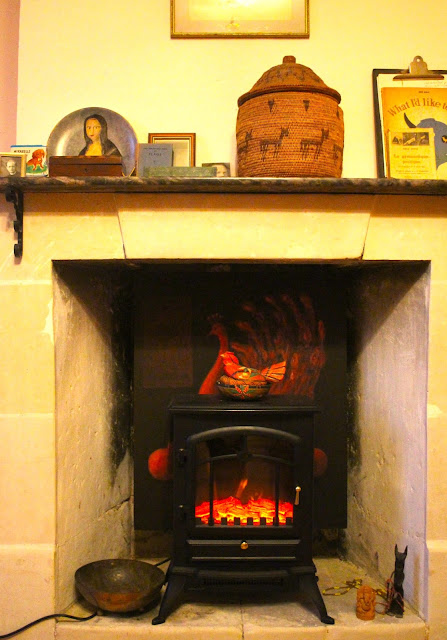
After being in our new house for a few months we have experienced a few cold days and can imagine what it might be like on a dank february day so for that reason recently went to a wood-burner shop in the local town and sort of fell in love with a small, cute red Canadian stove that was EEK expensive. On returning to the house and the room it would be situated in we justified the expense and went ahead to ask the shop owner to pay us a visit, survey the chimney situation and give us a quote. He did and the quote arrived a few days later - the sort of quote that requires the opening of a bottle and sitting down for some time in disbelief. Admittedly, the chimney is quite tall, and the tubage required no doubt very expensive as it was red to go with the stove, even though I'd said bog standard black would be fine...

We tried the wheely oil radiator for a few evenings but it's a big room and it barely made much impression so I looked at cheaper stoves and then somehow - as you do on the Net - ended up peering at electric 'wood' stoves. No lugging wood upstairs; click of a switch and heat would appear . . . attractive as we already have a big stove downstairs. Ideas change when one inhabits a new house for a while; things you had assumed about room usage don't necessarily stick. Case in point for this oversized bedroom. We had assumed it might become a species of second sitting room but all life revolves in and around the kitchen with afore-mentioned large stove. So, apart from sleeping and stuff and watching TV with hot water bottles (heaven) was it really necessary to invest a large amount of our savings on the real thing?

After looking at the electric stoves with a wry smile and raised eyebrow Mark agreed it might be the best option. I ordered it and the van magically appeared two days later. 'Will we be able to get it up the stairs' he had said as we went to sign for the box. I reminded him it had cost around 100 euro so was unlikely to be made of cast iron. The box was very much smaller than we had imagined. The 'stove' too - about the size of an average hotel mini bar. And it was made of plastic. Plastic! I'm sure the ad said métal noir - black metal. I just checked. It does . . . not sure how they got around that one. After laughing a lot and agreeing it was the naff-est thing we had ever bought we took it upstairs, screwed the legs on it and plugged it in. 

The fire has a heat and flame option or a just flame option. The heat setting is actually pretty efficient and quickly 'takes the edge off' the glacial air temperature compared to the oil heater which sits greyly emitting a slight warmth after about half an hour. But the weird thing is how comforting the just flame option is. The mind, (or at least mine) appears to be taken in by this little flickering pretend grate of 'logs'. Even though I know our purchase is future landfill (and I am ashamed to have added to this nightmare - it almost never happens!) I'm happy to have bought it, happy to have saved an enormous amount of money, and even feel quite fond of it and its little whirring sounds.


Sunday, 15 November 2020

Making do, exchanging, and farming methods.

A couple of weeks after we arrived in our new locality I tracked down all local suppliers of organic fruit and veg. Jean-Paul's place is a short bike ride away from us and his veg is simply incredible. He, his brother and mum have been honing their craft for the last 40 years here, sadly increasingly surrounded by monoculture as local farmers let out their fields to the big factory farm corporations. Their work is hard, and I know - or know fractionally - as we have been helping out a bit, but the satisfaction at the end of a day must be better than what the average factory farmer experiences. 

Our farmer neighbour has decided to let all his fields to a massive supermarket-supplying company based miles away from here, so vast machinery is brought, the fields flattened into sterile lines, mountains of sand and fertiliser imported and eventually crops such as mâche (weird, small salad thing) are sowed by special tractors after which another wheeled machine puts in metal bowed struts, after which plastic is stretched over, (by machine) after which another machine punctures the plastic to inject a dose of insecticide/herbicide... and so on. It seems an awful lot of effort/waste/environmental damage so that people can eat tasteless small bunches of leaves (which most French leave on the side of their plate anyway).

Up the road, Jean-Pauls place is a seemingly chaotic jumble of fruit crates, old poly-tunnels, tools, chickens, antique tractor parts, horses, germinating seeds in trays and his patchwork of small fields striped with carefully tended crops - currently, potatoes, carrots, broccoli, various types of cabbage, lettuce, the end of the tomato crop, coriander, parsley, beetroot, leeks, a few late strawberries, fennel, celery... all of it non-treated and mulched with leaves, mowings and horse dung.


                             Not J-P, or his crops as it was raining when I went to take a picture

Recently, when buying veg, we mentioned we'd like to once again have chickens, after leaving 'the Gladys' at our old house (with the new buyers caring for them). Jean-Paul said there were four sister chickens available and so we prepared the hen area: a fenced pen and part of an outbuilding with an old sideboard re-purposed as egg-laying place with straw-filled fruit crates. Mark made a ladder out of found wood from the out-building's window down to their pen. The making do element was further extended to repairing the glassless window with one of those see-through plastic 'lampshade' dog collar attachments to prevent hound-extremity scratching. I was slightly peeved as I'd already re-purposed it as a leaf collecting device. A minor detail.

We went round to the farm at dusk when the chickens would be sleepy and he bagged the four up, literally into a large heavy duty potato bag and invited us in for an apero. We sat in their kitchen and drank herby spirit of some sort and discussed chicken behaviour, making ponds and the inevitable end of our particular civilisation. When retrieving the bag, Mark asked whether he would like cash or an exchange by way of work time. He opted for the latter and two days later we were pulling carrots in the sandy loam that makes up J-P's fields.

Carrot pulling is very satisfying; a gentle rocking and twisting motion but not too hard or the carrot will snap; then a determined grip on the top and out it slides sandily from the carrot shaped hole. Or not. These are highly organic legumes and a few develop into whole carrot citadels which take a little more work to extract. We filled wooden crates for two hours. Mark pushed them back to the farm headquarters discovering new muscles, after which I learned the art of broccoli cutting with a scarily sharp knife.

We left at lunchtime feeling happily tired with a bag of misshaped carrots, broccoli, and herbs for drying above the fire. That was just a few hours but added to the large amount of gardening later . . . well, we slept very heavily. I now regard carrots, broccoli and radishes (from a previous morning's work) with a different eye in supermarkets, thinking of the physical work involved, or in the case of the plastic bags of salad, the amount of machinery involved.

The chickens, being wilder than our previous flock, have ignored our re-purposed sideboard, outbuilding and window and have taken to roosting in one of the nut trees, as they did back at Jean-Paul's farm. And that's fine, although we may have to hunt the eggs as he does - alerted by the chicken's egg-laying song as he put it. Rather poetic. 


Wednesday, 11 November 2020

Celebration

A minuscule one of importance only to me, but a celebration none the less. Having just reached 90,000 words in my latest novel, the ending is in sight - which then just means an astronomical amount of re-writing as the plot is so convoluted that I am lost in my own literary maze, without Google maps, or even a small mangled paper version. 

It seems to be the way I work though and I know there are great authors out there who experience the same 'method'; Steven King for one, of whom I recall saying his characters just develop without his control, and Will Self who plows through draft one without stopping and then starts on the grand re-write. Writing for me is like my own experience of playing chess; I can't think more than a move ahead as my mind starts wandering about - considering lunch ideas or wondering how we could improve the chicken enclosure/our income (ha) etc.

Below, an extract. Marion (main character who is currently in Pendingville after her demise while trapped the back end of a panto-horse) is on a Heaven taster-trip with acquaintance, Quentin Faraday, an ex- very successful and egocentric - conductor. Their normal conversational exchanges seem to be alarmingly altered.

“Good morning, dearest friends, oh, and you have brought new acquaintances with you. How simply delightful.” 

The receptionist's voice was pure Merchant Ivory film. Or perhaps she really was from a 1870 English country mansion. Marion imagined her dressed in silks and brocades rather than the neat white uniform.    

“Sorry to be inquisitive but can I ask what year you came from before Heaven?” 

 “Not inquisitive in the slightest . . . 1856.”

 “And you chose Heaven after Pendingville?”


“Indeed. I was, what my guidance officer referred to as, fast-tracked to Heaven as my life had been deemed to be one of unerring faith and charity.” The woman paused to refasten an escaped curl of red hair that had become dislodged from its neat bun. The small act completed she smiled at them all in turn. “If you would care to follow our friends they will introduce you to the celestial cleansing boudoirs.”


Marion was led by to a cubical lit by electric candles and decorated with garlands, buddahs, holy Marys, Shivas and a host of other effigies. Incense drifted. A soundtrack of tranquil streams, four chord piano and bird song played. Slight panic enveloped Marion, a feeling that she could easily forget to return to the meeting point if she became sufficiently immersed in this unfamiliar territory. However the massage table did look inviting. 

At the woman’s invitation, Marion stripped off her garments, took a shower in the en-suite room and returned to lie down and be subjected to oils, flowers, gentle pummelling, recitations, badly sung Gregorian chants, sips of honey water and confirmations that Heaven was the place to be, eternally. Her internal response was to scream, peel herself from the table and run away as fast as possible but she found herself uttering niceties, singing along and agreeing that this was, certainly, was the place to be.

    Some hours later Marion left the building oiled, limp and with holy chanting alive in her ears. Quentin was sitting on a rock looking out over the ocean. She wandered over to him hoping they could join in some healthy sarcasm but it seemed not. He glanced up at her and patted the rock, his words hesitant, brow momentarily furrowed.

    “. . . Christ, urg, ahh . . .” His brow softened as if an internal mechanism was forcing the action . “I mean, well, what an experience. Did you try the honey water?”


Marion’s words emerged somewhat differently to what she was thinking. “. . . Yes. Sublime, wasn’t it, and you must have loved that beautiful music, the string section, panpipes, stream, waterfall, choir,  rainstick, birdsong . . .”


He spat his response after a pregnant delay. “. . . Yes! Divine! And the chanting . . . so relaxing.” His eyes appeared strained, hands jerkily conducting an imaginary orchestra with a twig. “Do you recall where and when we came in – not that I’m looking forward to leaving, oh no, quite to the contrary!”


“Yes – over . . .” The gates seemed to have disappeared, or they had perhaps been escorted further than Marion had recalled, “there, somewhere. But as you quite rightly say, not really important. Did your assistant tell you about the concert later?”


Quentin’s eyes bulged a little. “YES, he didFour harps, child choir, bagpipes and guesting, Klaus Wunderlich and . . . Liberace!”


“Really? The Liberace.”


“And, the Klaus Wunderlich.” Quentin sobbed momentarily, “sorry, I’m just a little emotional. It’s going to be so . . . wonderful. And then there’s the macramé exhibition to go to and the cupcake icing contest.”


Marion nodded, the action automatic. “Yes, wonderful. I’ve always wanted to learn macramé and cupcake icing will be a very valuable skill to acquire . . . by the way, have you seen the others since you left the cleansing?”


“Only one. That guy called Nigel – VAT inspector. He was dressed in orange robes and chanting like those people in Oxford Street . . .”


“Hare Krishna.”


“Them, yes.”


“Was he happy?”


“He appeared to be, yes, wildly.”


“How wonderful. I expect we’ll see them at the concert.”


Quentin dropped the twig and bunched his hands into fists, his voice squeaky as if trying to force words to emerge. “Marion?”


“Yes, Quentin?”


His hands relaxed and hung limp over his knees. “. . . Nothing. Hungry?”


“Not really. I had a low fat cream cheese and fresh herbs rice-cake sandwich after the massage. It was really lovely.”